02 / Buying a home · 5 minute read
How much can they spend on a home?
Aarav and Meera like a ₹1.2 crore home. They earn ₹1.8 lakh a month after tax. How much would be left after the home loan payment and other expenses?
They want to keep investing ₹25,000 a month for retirement. Change the home price below to see the monthly loan payment, or EMI, and how much money they would have left.
- Monthly take-home income
- ₹1.8 lakh
- Monthly investment for retirement
- ₹25,000 / month
- Living expenses, excluding rent
- ₹55,000 / month
- Unexpected costs + home maintenance
- ₹15,000 / month
Aarav and Meera are fictional. We assume their ₹25,000 rent stops when the home loan payments start. This example includes no other loans or education costs.
₹1.2 crore home · 8.5% loan
₹1,689
left each month after the costs shown here
The ₹1.2 crore home leaves very little each month.
An ₹80 lakh home leaves ₹29,459. A ₹1.2 crore home leaves ₹1,689. Both fit within the monthly income, but only just at the higher price. A holiday, a large repair or a drop in income would be harder to manage.
Getting the loan approved does not tell them whether they will be comfortable paying it.
01 / THE CASH NEEDED TO BUY
Can they pay the down payment and other charges?
At the selected price of ₹1.00 crore, the couple needs ₹26.00 lakh at the time of purchase, before furniture or moving costs.
That is ₹20.00 lakh for the down payment plus ₹6.00 lakh for estimated purchase charges. Being able to afford the EMI does not mean they have this money saved.
If they use retirement savings to buy the home, they will have less money invested for retirement. Their plan needs to account for this.
Living costs and the ₹25,000 retirement investment stay the same for each price. Money left may still be needed for other goals or expenses.
02 / A HIGHER INTEREST RATE
What happens if the interest rate rises?
Choose 10.5% in the interest-rate menu above. The EMI rises even though the home price is the same. A negative balance means their monthly costs exceed their income.
They would need a smaller loan, a cheaper home or lower spending elsewhere. The rates here are examples; a bank may offer a different rate.
What StratLab helps them check
“How much can we spend on a home and still save for our other goals?”
In a full plan, they can add their purchase date, savings, loan payments and retirement needs. They also need to include an emergency fund and other family goals.
Explore the home planner →HOW THIS LOOKS IN STRATLAB
Can the monthly budget cover all their goals?
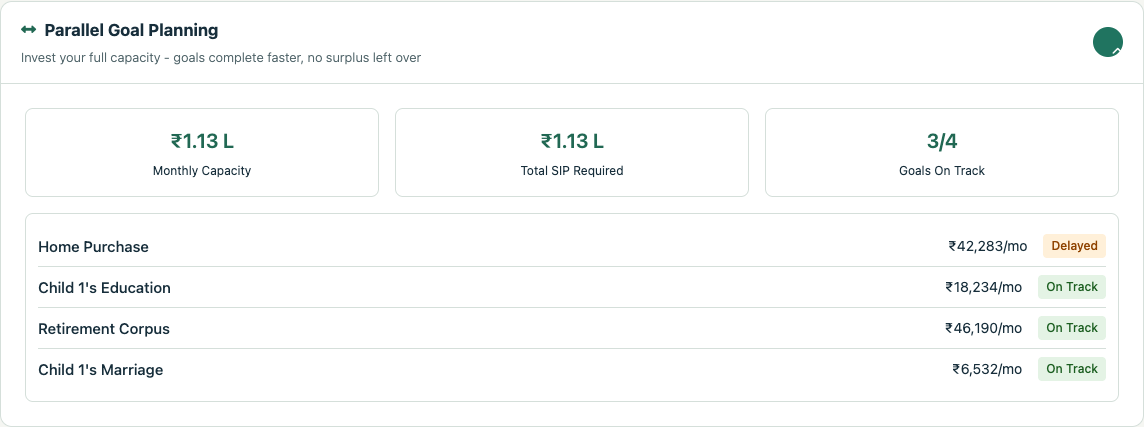
A family might afford each goal on its own, but struggle when they need to save for all of them at once.
This screenshot shows a different fictional household dividing its monthly investment across four goals. In this calculation, they can reach three goals on time, but need longer to save for the home. StratLab shows this before they commit to a purchase date.
UNDERSTAND THE CALCULATION
What the numbers include
Income, expenses and purchase costs used here
From their ₹1,80,000 monthly take-home income, we subtract ₹55,000 for living costs excluding rent, ₹25,000 for retirement, ₹10,000 set aside for unexpected costs, ₹5,000 for home maintenance and the EMI. Setting aside ₹10,000 a month does not mean they already have an emergency fund. We keep the retirement investment at ₹25,000; a separate retirement calculation is needed to check whether that is enough.
The home loan covers 80% of the price and is repaid through 240 monthly EMIs over 20 years. The calculator divides the annual interest rate by twelve to get the monthly rate. When you choose a higher interest rate, the loan amount and 20-year period stay the same. A bank may instead extend the repayment period for a floating-rate loan.
The cash needed at purchase includes a 20% down payment and an estimated 6% for purchase charges. The 6% is only an example, not a quoted stamp duty or registration rate. Actual charges depend on the property and location. Furniture, moving, loan fees and unexpected repairs are extra. We assume they buy now, so no future rise in property prices is included.
Compare the three home prices in detail
| Home price | Cash needed to buy | EMI | Money left each month |
|---|---|---|---|
| ₹80,00,000 | ₹20,80,000 | ₹55,541 | ₹29,459 |
| ₹1,00,00,000 | ₹26,00,000 | ₹69,426 | ₹15,574 |
| ₹1,20,00,000 | ₹31,20,000 | ₹83,311 | ₹1,689 |
What the comparison leaves out
We assume their ₹25,000 rent stops when they move in and the EMI starts. If they pay both for a while, they will need extra money. This example does not include other loans, education costs, future income changes or rising maintenance costs. It checks their monthly budget now; it does not predict the next 20 years, assess loan eligibility or compare renting with buying.
Savings used to buy the home are no longer available for retirement. A full plan needs to show where the purchase money comes from and how that affects the other goals.
Sources, limits and a download of the calculations
These examples use fictional households, not actual customer results. They explain planning choices and do not recommend any investment. For comparison, we assume the same return each year. Real returns vary and can be negative. Taxes, investment fees and unexpected expenses are excluded unless stated. Having money left each month does not mean every goal is fully funded.
The results come from StratLab’s calculators. Moving a slider changes only this example, not your saved plans. Amounts shown are rounded. Download the starting numbers and results (JSON) for every option in this example.
Read about StratLab’s calculation assumptions. SEBI explains why goals, time horizon, liquidity, risk and taxes matter; AMFI explains investment uncertainty. These sources explain the planning principles. They do not endorse the return rates used in this example.
TRY YOUR OWN NUMBERS
See how your own goals fit together
Enter your income, rent, savings and planned purchase date. Check the home budget alongside your retirement and other family goals.
Start without signing in. Speak to DBI only if you choose to.