01 / Planning for retirement · 5 minute read
Can Neha retire at 50, 55 or 60?
Neha is 35 and wants to retire at 50. She has saved ₹20 lakh and can invest ₹65,000 a month. Will that be enough?
She wants her retirement savings to cover a lifestyle that costs ₹60,000 a month today. Change her retirement age below to see how much she would need to invest each month.
- Age now
- 35
- Already saved
- ₹20 lakh
- Monthly spending today
- ₹60,000
- Can invest each month
- ₹65,000 / month
Neha is a fictional person. Her ₹20 lakh is saved only for retirement. This example plans for her expenses until age 90.
Retiring at 50 compared with 55
₹35,886
less to invest each month if she retires at 55
Retiring five years later reduces the monthly amount.
With returns of 10% before retirement and 8% after, retiring at 55 means she has five more years to invest. Her existing ₹20 lakh also has longer to grow, and her savings need to cover five fewer years of expenses. The amount she needs to invest each month falls from ₹97,153 to ₹61,267.
To retire at 50, Neha would need to invest ₹32,153 more each month than she can afford today. She can now compare retiring later, spending less in retirement or finding a way to invest more.
01 / TIME TO SAVE AND YEARS TO COVER
How many years must her savings last?
If she retires at 55, Neha has 20 years to invest and 35 years of retirement expenses to cover.
A later retirement gives her more time to invest and fewer years of expenses to cover. Both affect how much she needs to save.
The timeline changes with the retirement age you choose. In every case, her savings need to cover expenses until age 90.
02 / WHY THE TOTAL CAN BE MISLEADING
Why does retiring at 60 need a bigger total, but less each month?
Prices keep rising while Neha works. So the total she needs at 60 is higher than at 50. But she also has ten more years to invest, which reduces the monthly amount needed.
StratLab shows the retirement age, expected expenses and monthly investment together. Looking only at the total savings needed could lead Neha to the wrong conclusion.
₹4.74 crore in 2041 rupees
₹5.78 crore in 2046 rupees
₹6.92 crore in 2051 rupees
HOW THIS LOOKS IN STRATLAB
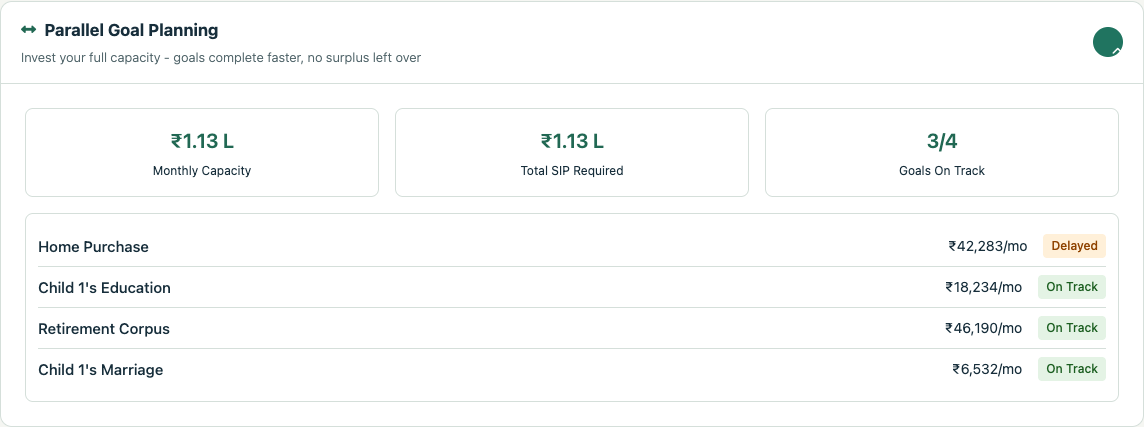
Can the monthly budget cover all their goals?
A family might afford each goal on its own, but struggle when they need to save for all of them at once.
This screenshot shows a different fictional household dividing its monthly investment across four goals. In this calculation, they can reach three goals on time, but need longer to save for the home. StratLab shows this before they commit to a purchase date.
UNDERSTAND THE CALCULATION
What the numbers include
Her starting numbers and how we calculate the result
The calculation starts on 1 October 2026. Neha is 35, has ₹20 lakh saved for retirement and wants to cover expenses costing ₹60,000 a month today. We compare the result with the ₹65,000 she can invest each month now. We do not predict what she will be able to afford in future. No other income or savings are added, and no money is set aside to leave to family.
- Increase today’s expenses by 6% a year until retirement.
- Calculate the savings needed to pay her expenses at the start of each month until age 90. Expenses rise by 6% on each anniversary of retirement.
- Calculate how much her existing ₹20 lakh could grow to by retirement. Subtract that from the total savings needed.
- Use StratLab’s SIP calculator (for regular monthly investments) to find the amount needed to cover the gap. She invests the same amount at the start of every month. The monthly amount may be up to ₹1 higher than the exact calculation.
The first option assumes annual returns of 10% before retirement and 8% after. The lower-return option uses 8% and 6%. These rates are chosen for comparison, not promised returns. Future amounts include the assumed rise in prices. This calculation does not check whether Neha can keep investing the same monthly amount as her living costs rise.
Compare ages 50, 55 and 60 in detail
| Retire at | Years retired | Monthly expenses at retirement | Total savings needed | Monthly investment needed |
|---|---|---|---|---|
| 50 | 40 | ₹1,43,793 | ₹4,73,73,102 | ₹97,153 |
| 55 | 35 | ₹1,92,428 | ₹5,78,11,236 | ₹61,267 |
| 60 | 30 | ₹2,57,512 | ₹6,91,58,776 | ₹38,201 |
What could make this plan fall short?
Living past 90, faster price rises, taxes, fees, unexpected medical bills or lower returns could mean she needs more. Investment losses early in retirement can also cause problems. Read why the timing of returns matters.
All of the ₹20 lakh is available for retirement. None of it is locked in an account that she can access only later, or needed for a home or education. A full plan needs to account for those restrictions and other goals. Assuming the same return every year does not tell us how likely the plan is to succeed.
Sources, limits and a download of the calculations
These examples use fictional households, not actual customer results. They explain planning choices and do not recommend any investment. For comparison, we assume the same return each year. Real returns vary and can be negative. Taxes, investment fees and unexpected expenses are excluded unless stated. Having money left each month does not mean every goal is fully funded.
The results come from StratLab’s calculators. Moving a slider changes only this example, not your saved plans. Amounts shown are rounded. Download the starting numbers and results (JSON) for every option in this example.
Read about StratLab’s calculation assumptions. SEBI explains why goals, time horizon, liquidity, risk and taxes matter; AMFI explains investment uncertainty. These sources explain the planning principles. They do not endorse the return rates used in this example.
TRY YOUR OWN NUMBERS
See how your own goals fit together
Add your age, expenses and existing savings to see what retirement could require. Include your home loan and family goals to check what you can afford to invest.
Start without signing in. Speak to DBI only if you choose to.