03 / Saving for education · 5 minute read
Start saving now, or wait three years?
Riya and Kabir want to pay for their child’s education without using their retirement savings. How much more would they need to invest each month if they wait three years?
After their expenses, they can invest ₹60,000 a month: ₹35,000 for retirement and ₹25,000 for education. The course starts 12 years from now. Waiting to invest will leave them less time to reach the same target.
- Course cost today
- ₹20 lakh
- Course starts in
- 12 years
- Can invest for education
- ₹25,000 / month
- Monthly investment for retirement
- ₹35,000 / month
Riya and Kabir are fictional. They have not yet saved for education. For this example, the full course fee is paid when the course starts.
Starting now compared with three years later
₹10,708
more needed every month
Waiting three years takes them over budget.
With a 10% annual return and fees rising 8% a year, starting now needs ₹18,632 a month. Waiting three years needs ₹29,340—above the family’s ₹25,000 education budget.
The course and its start date stay the same. They just have fewer months to invest and less time for the money to grow.
01 / LESS TIME TO SAVE
Waiting three years leaves nine years to invest.
The course still starts 12 years from today, even if they wait three years to begin investing.
That leaves nine years to save. The expected course fee still includes 12 years of fee increases, because those increases do not stop while the family waits.
12 years · same course date
9 years · same course date
02 / WORKING WITH THEIR BUDGET
What if they cannot invest more than ₹25,000 a month?
With the start date you selected, investing ₹25,000 a month for 12 years could grow to ₹67.58 lakh using the return rate you selected.
Investing ₹25,000 a month could cover the expected course fee under these assumptions.
If there is a gap, they could start sooner, use other savings, choose a less expensive course or invest more each month. Using retirement savings would leave less for their own future.
How they divide their ₹60,000 monthly investment
- For retirement
- ₹35,000
- Available for education
- ₹25,000
StratLab shows how much is available for each goal. The same ₹60,000 cannot be counted in full for both education and retirement.
The full plan also needs to check whether ₹35,000 a month is enough for retirement. This example only checks education.
HOW THIS LOOKS IN STRATLAB
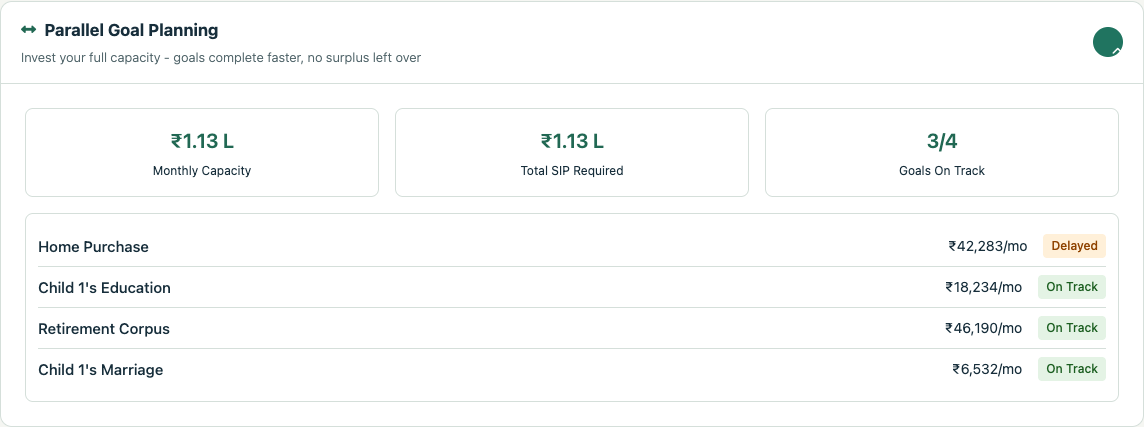
Can the monthly budget cover all their goals?
A family might afford each goal on its own, but struggle when they need to save for all of them at once.
This screenshot shows a different fictional household dividing its monthly investment across four goals. In this calculation, they can reach three goals on time, but need longer to save for the home. StratLab shows this before they commit to a purchase date.
UNDERSTAND THE CALCULATION
What the numbers include
Course fees, investment returns and how we calculate the result
The course costs ₹20 lakh today. We assume the full fee is paid 12 years from now. A yearly increase of 8% for all 12 years brings the expected fee to ₹50,36,340 when the course starts. There are no existing savings for this goal.
StratLab’s SIP calculator (for regular monthly investments) finds how much they need to invest at the start of each month, assuming the investment grows by 10% over a year. Waiting reduces the number of months they invest, but fees still rise for all 12 years. The monthly amount may be up to ₹1 higher than the exact calculation. It also calculates how much their ₹25,000 monthly budget could grow to.
The lower-return option assumes 8% annual returns, with fees rising 8% a year. The higher-fee option assumes 10% annual returns, with fees rising 10% a year. These are examples, not promised returns or a quotation from a college.
Compare starting later, lower returns and higher costs
| What changes | Years to invest | Expected course fee | Monthly investment needed | Money left / extra needed each month |
|---|---|---|---|---|
| Start now | 12 | ₹50,36,340 | ₹18,632 | ₹6,368 |
| Lower investment return | 12 | ₹50,36,340 | ₹21,208 | ₹3,792 |
| Higher education cost growth | 12 | ₹62,76,857 | ₹23,221 | ₹1,779 |
| Start three years later | 9 | ₹50,36,340 | ₹29,340 | −₹4,340 |
What else an education plan needs to include
In practice, fees may be paid over several years. You may also need to include living costs, exchange rates for overseas study, scholarships, education loans, taxes and investment fees. This example assumes one payment, the same return each year and no existing education savings. Market losses just before the course starts could leave the family short of money.
Setting aside ₹35,000 a month does not prove they have enough for retirement. Read the retirement example to see what else needs checking.
Sources, limits and a download of the calculations
These examples use fictional households, not actual customer results. They explain planning choices and do not recommend any investment. For comparison, we assume the same return each year. Real returns vary and can be negative. Taxes, investment fees and unexpected expenses are excluded unless stated. Having money left each month does not mean every goal is fully funded.
The results come from StratLab’s calculators. Moving a slider changes only this example, not your saved plans. Amounts shown are rounded. Download the starting numbers and results (JSON) for every option in this example.
Read about StratLab’s calculation assumptions. SEBI explains why goals, time horizon, liquidity, risk and taxes matter; AMFI explains investment uncertainty. These sources explain the planning principles. They do not endorse the return rates used in this example.
TRY YOUR OWN NUMBERS
See how your own goals fit together
Add your child’s expected course fee, the start date and how much you can invest. Include retirement in the same plan to check whether both goals fit your budget.
Start without signing in. Speak to DBI only if you choose to.